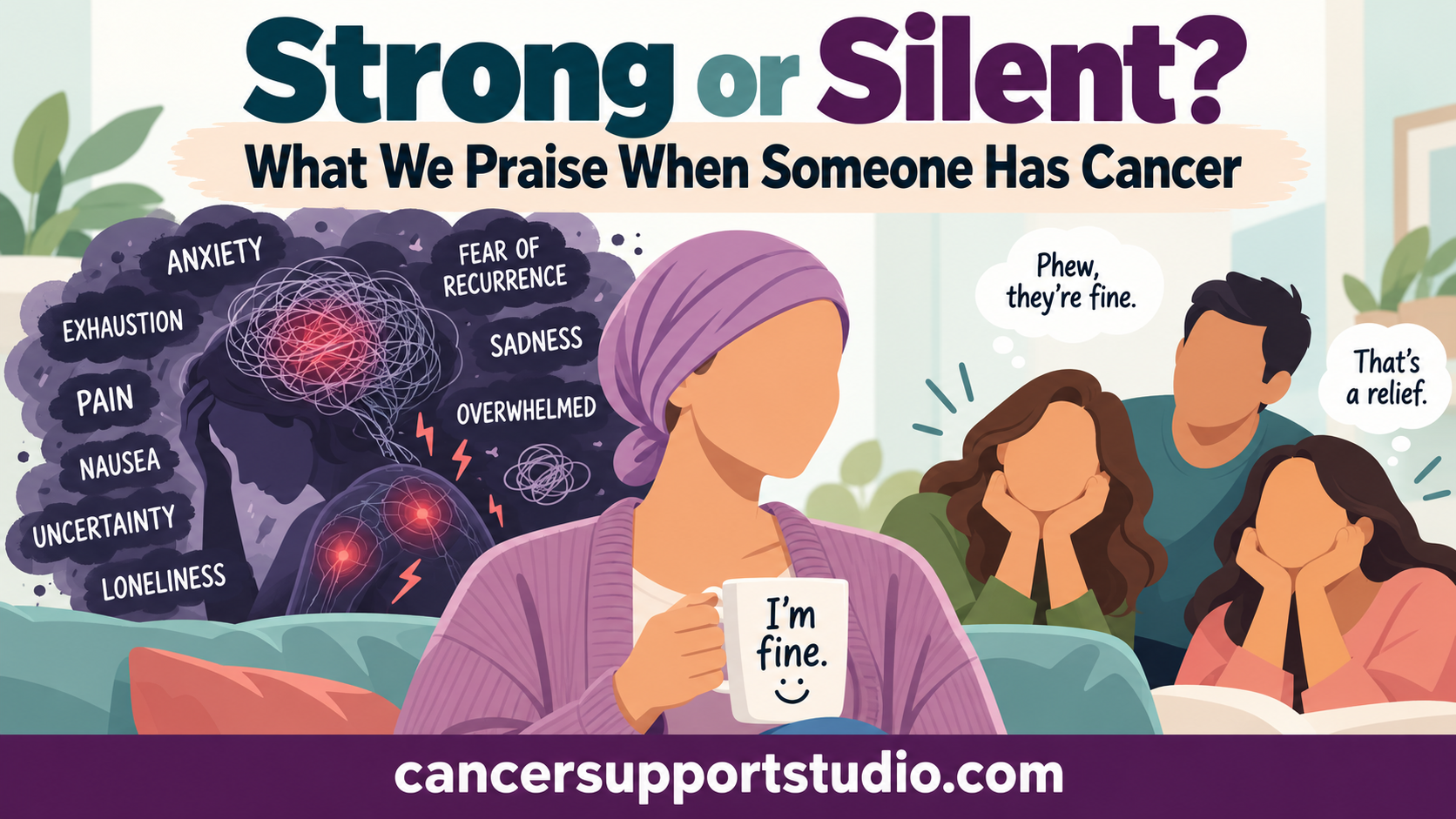
What We Praise When Someone Has Cancer
You smile at the nurse and say you’re fine. Later, a neighbor stops you at the grocery store and tells you how amazing you look. You thank her, check out, and sit in the car for ten minutes because you don’t have the energy to drive home and carry the groceries in.
Then someone says it. “You’re so strong. You never complain.” It sounds like a compliment, and most of the time it comes from a kind place. But if you’ve lived with cancer for any length of time, you’ve probably felt the little sting in it. Because what they noticed wasn’t your strength, they noticed that you kept the hard parts out of their way.
The Compliment With a Catch
We tend to praise cancer patients for the things that make life easier for everyone else. Staying positive, keeping busy, and not “making it about the cancer” all get applause. On the other hand, crying in public, asking a lot of questions, or admitting you’re scared can earn you a look that says you’re not handling it well, making others uneasy and avoidant. So without meaning to, we teach patients a rule: be brave, and brave means always staying positive or staying silent.
That push to stay positive has a name, toxic positivity. It sounds like “Everything happens for a reason,” “At least they caught it early,” or “Just stay positive and you’ll beat this.” People say these things to comfort you, but they shut the conversation down. You can’t be scared or angry when someone has already told you how to feel. Hope is good. Forced cheer that leaves no room for the hard days only teaches you to keep the truth to yourself. It even follows you into the exam room, where saying “I’m doing pretty good” to please your doctor means they never hear about the symptoms that need attention.
The quiet side of this has a name too, masking. It means hiding what you feel so you don’t upset anyone. Quiet patients know their natural human emotions make others uncomfortable, and they pay for it. When you keep smiling through pain, people assume the pain is small. When you don’t push back, doctors assume you’re satisfied. And when you hide the bad days from your friends, they stop asking about them.
Most people in your life care about you. They send the heart emoji with “thoughts and prayers”, they say “let me know if you need anything,” and they mean it. The trouble is that “let me know” puts the work back on you, and when you’re exhausted, asking for help can feel like one more job. So the offer sits there, and life keeps everyone busy. Then there are the few who show up without being asked. They text the morning of your scan, leave soup on your porch, or sit with you in a waiting room for three hours with nothing to do. Those people are unicorns. When you find one, keep them close and let them know what their effort means to you.
Where This Hit Home for Me
I was diagnosed with early onset chronic non-muscle invasive bladder cancer in 2018. Before that, my symptoms were treated as UTIs and kidney stones, which is a pattern a lot of women with bladder cancer know too well. Premenopausal women can even mistake blood in their urine for their period, so the delays stack up.
Some patients stay quiet because they want to be the “good patient.” They don’t want to seem dramatic, so they trust the doctor and try not to be a bother. That wasn’t me! I spoke up, and I was still dismissed again and again. What I learned was to keep my emotions in check during appointments, because I knew that if I seemed “too emotional,” doctors would label it a mental health issue instead of looking for what was wrong with my body.
Eventually, I got tired of being brushed off. I started asking harder questions, and I fired doctors who misdiagnosed, dismissed or did not give me quality care. I filed complaints when I needed to, and I corrected my medical records when they were wrong. I even demanded that providers to correct misinformation in visit summaries, because those inconsistencies stay in your records and could improperly get passed on to other providers. Some people would call that difficult. I call it the reason I’m still here, eight years later, with my bladder. You must be your own best advocate.
Cancer also showed me who my people were. After my diagnosis, I lost nearly my entire support system, including people I thought were close friends. Some faded out slowly with fewer texts and canceled plans, while others disappeared overnight. I got cancer ghosted hard, and that hurt almost as much as the diagnosis. But a few people stepped up when everyone else stepped back. They checked on me, showed up, and stayed. Those are my golden unicorns, and I hold on to every one of them.
Why Quiet Gets Rewarded
People around you are scared too. When you look okay, they get to feel okay, so your calm face becomes their comfort. That’s human, but it puts the weight on the person who already has the most to carry. At the end of the day, being a patient can feel lonely in a way that’s hard to explain and we don’t know how to be vulnerable. You start to believe no one understands or cares how bad it gets. So you hold back how you feel, because you don’t want to dump your pain on the people you love. And if we’re honest, they don’t want to carry it either, nobody does. Relationships around cancer turn into a careful balance. Everyone stays kind and supportive, as long as it doesn’t get in the way of their own life and their own struggles.
Medical systems also run smoother when patients don’t slow things down. A patient who says “I’m fine” is easier to move along than one who says “Something still feels wrong.” That gets harder if you’re already more likely to be dismissed by doctors. This includes women, younger and older patients, people of color, people in larger bodies, people with disabilities, LGBTQ+ patients, and anyone from a marginalized or underserved community. When your symptoms get brushed off, staying quiet can lead to a wrong diagnosis or one that is too late.
What Strength Looks Like
Strength is often loud and a little messy. It looks like:
- Asking your doctor to explain something a second time
- Getting a second opinion when your gut says something is off
- Telling a friend the truth when they ask how you are
- Saying no to a visit because you need rest
- Crying, and letting someone see it
- Bringing a written list of questions and not leaving until they’re answered
- Telling your loved ones when they are being inconsiderate
None of that is weakness. In fact, it takes more nerve than smiling through it.
For Friends and Caregivers: What to Say Instead
If you love someone with cancer, try swapping the “you’re so strong” line for something that leaves room for the truth.
- “You don’t have to be okay with me.”
- “What’s been the hardest part this week?”
- “Do you need someone to take you to your appointment?” then actually confirm the time and take them.
- “Do you want me to listen, or help you fix something?”
- “I’m dropping off dinner Thursday. You don’t need to clean or talk.” Drop-offs are welcomed, just let them know ahead of time.
- “I’m at the store, what do you need and I can drop it off.” Mail or drop off a note of encouragement with a treat or something to put a smile on their face.
- “I’m here to listen, tell me.” Do not interrupt, be curious but not too intrusive. If they have a need that is small, just go get it and drop it off without acknowledgment or expectation.
- “Do you want to try to get out for a short time?” Think of simple and small trips, to a park, a movie, to pick up meds, or just for a drive around the neighborhood to get some sun and fresh air.
- Texting someone periodically to check on them, “Just letting you know I am thinking of you and sending love. You don’t need to answer unless you want to chat.”
- “I’m proud of you for speaking up at that appointment.” Or if you go with them, pay attention, take notes, ask questions.
Notice that last one. When you praise someone for advocating for themselves, you tell them that speaking up is the strong move.
For You: Permission to Be a Little Inconvenient
If you’re the patient, here are a few phrases worth keeping in your back pocket:
- “I’m not fine today, but thanks for asking.”
- “Can you write that down for me?” Can be for the provider or loved one.
- “I want this noted in my chart.”
- “I need a few days before I see anyone.”
- “What is your differential diagnosis?”
- “Slow down, I have more questions. Can you explain…”
You have my permission and are allowed to take up space and your questions are worth the doctor’s time, and your bad days are worth your friends knowing about.
Keep Track So You Can Speak Up
One thing that helped me push back was having my notes in one place. When you can point to dates, symptoms, and what a doctor said last time, it’s harder for anyone to wave you off. That’s a big reason I created the Cancer Care Book. It has room for appointments, medications, symptoms, and the questions you don’t want to forget in the exam room. It also has space to jot down notes or just how you feel so you can refer back to it later.
And if you need help finding support, financial help, or someone who gets it, start with our growing list of cancer support resources.
You don’t have to suffer quietly to be strong. You only have to keep showing up as yourself, loud parts included, because you matter and deserve to be heard and considered.
We got this friends! <3